What Are Service Charges and Who Sets Them?
Service charges are mandatory annual fees paid by property owners to cover common area maintenance, utilities, security, and reserves. They're not optional—they're levied by either the Owners' Association or Community Management and enforced by RERA (Real Estate Regulatory Authority).
Who sets them? In older communities (pre-2008), Owners' Associations (volunteer-run boards elected by residents) set charges. In newer communities (2008+), property developers appoint professional Community Management companies to run operations, and these firms propose charges approved by RERA.
Legal authority: RERA Circular 57/2017 establishes the framework. Service charges are a lien on your property—if you don't pay, the management company can foreclose. This is rare but possible, making unpaid service charges a serious compliance issue.
Who pays? Property owners pay. If you have a mortgage, the bank often requires you to escrow service charges in your mortgage payment. If you're renting out your property, you typically pay charges, though some leases shift this to tenants (less common now due to tenant protections).
Frequency and collection: Charged annually or semi-annually. Collection happens via post-dated cheques, bank transfers, or automatic deductions. Late payment incurs interest (typically 1% monthly) and potential legal action.
The key insight: Service charges are not negotiable. They're set by management based on community operating budgets. Your only recourse is disputing unreasonable increases through RERA if a charge spike exceeds 10% annually without justification.
What's Included in Service Charges: The Full Breakdown
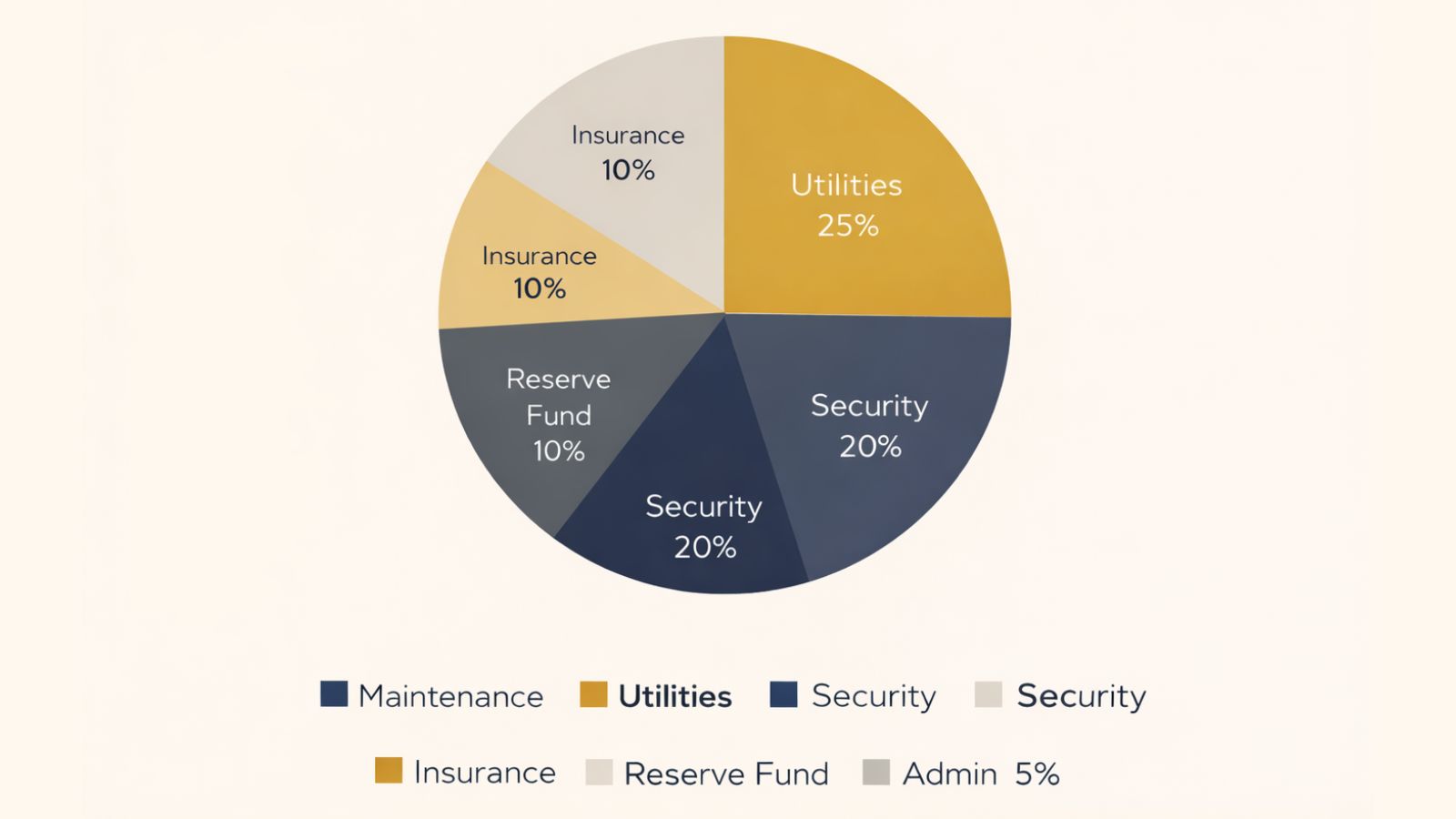
Service charges cover everything needed to operate a community. Here's the typical allocation:
Common Area Maintenance (25-35% of charges)
- Landscaping, gardens, and parks
- Water features (pools, fountains, water bodies)
- Lighting in common areas
- Roads, parking lots, and driving surfaces
- Building facades, roofs, and exteriors
- Lifts, escalators, and mechanical systems
- Gym, spa, and recreational facilities maintenance
Utilities and Infrastructure (20-30% of charges)
- Water treatment and pumping
- Sewage treatment
- Electricity for common areas
- Waste management and recycling
- Building management systems (BMS) and automation
- Backup power systems
Security (15-20% of charges)
- 24/7 security personnel (gates, patrols, CCTV monitoring)
- Technology: CCTV cameras, access control systems
- Perimeter fencing and barriers
- Security vehicle maintenance
- Incident response and emergency protocols
Management and Administration (10-15% of charges)
- Salaries for building managers and coordinators
- Community management company fees
- Office operations
- Insurance (liability and property)
- Legal and compliance services
- Accounting and audits
- Maintenance of community records
Reserves and Contingencies (5-10% of charges)
- Major capital repairs (façade cleaning, re-painting, structural work)
- Equipment replacement (lifts, boilers, generators)
- Unexpected emergency repairs
- Reserve fund for future developments
Additional services (vary by community)
- Concierge and guest management
- Valet parking services
- Swimming pool and beach management
- Golf course maintenance (in premium communities)
- Shuttle services
- Pet care facilities
- Kids' clubs and childcare
- Spa and wellness programs
Service Charges by Area: What Owners Actually Pay in Dubai in 2026

Service charges vary dramatically by location. Here's what owners are paying across Dubai's major communities in 2026:
Downtown Dubai
Downtown is one of the most expensive areas for service charges. The Burj Khalifa apartments average AED 3,500–5,000 per unit annually (approximately USD $950–1,360). Nearby residential towers in Downtown average AED 2,000–3,500 annually (USD $545–950). Why so high? Premier location, luxury amenities (spas, gyms, concierge), 24/7 security, and the cost of maintaining iconic buildings.
JBR (Jumeirah Beach Residence)
JBR is one of the largest and oldest residential developments. Service charges average AED 1,500–2,000 per unit annually (USD $410–545). The variation depends on which tower you're in. Beachfront units may pay more due to additional beach maintenance.
Dubai Marina
Marina is a mixed-use waterfront development with premium amenities. Service charges typically range from AED 2,000–3,500 annually (USD $545–950). Why the variation? Proximity to water, amenities tier, and tower age. Newer towers with premium services cost more.
Palm Jumeirah
Palm Jumeirah is Dubai's most exclusive community. Service charges are significantly higher: AED 4,000–8,000+ per unit annually (USD $1,090–2,180+). Some ultra-luxury villas exceed AED 10,000 annually. The high cost reflects beach maintenance, private security, exclusive amenities, and limited unit density.
Emirates Hills
Emirates Hills is a villa community and is more affordable for service charges: AED 500–1,500 annually (USD $135–410). However, some residents report charges increasing as the community ages and capital maintenance becomes necessary.
Arabian Ranches
Arabian Ranches is another villa community with lower charges: AED 600–1,500 annually (USD $165–410). The development is well-maintained and includes equestrian facilities, contributing to the costs.
Downtown Jebel Ali (DTJA)
DTJA is a newer, master-planned community. Service charges are moderate: AED 1,500–2,500 annually (USD $410–680). The lower cost reflects newer infrastructure and efficient management.
Jumeirah Village Circle (JVC)
JVC is a more affordable residential area. Service charges are among the lowest in Dubai: AED 600–1,200 annually (USD $165–330). This makes it attractive to first-time buyers and investors.
Damac Hills
Damac Hills is a large mixed-use community. Service charges are moderate: AED 1,500–2,200 annually (USD $410–600). The development includes golf courses and premium amenities, which raises costs slightly.
Remraam
Remraam is a smaller, villa-focused community. Service charges are low: AED 800–1,200 annually (USD $220–330).
Why Do Service Charges Increase?

Service charges rarely stay flat. Here's why they increase:
1. Aging Infrastructure
As buildings age (typically after 5-10 years), major capital repairs become necessary. Roof replacements, façade cleaning, structural repairs, and mechanical system upgrades push costs up. Developers often underfund reserves initially, and charges spike once major work is needed.
2. Rising Operating Costs
Labor costs in Dubai have increased 15-25% over the past 5 years. Security staff, maintenance workers, and management salaries are higher. Utilities (water, electricity) prices have also increased, especially as communities invest in sustainability.
3. Inflation and Economic Factors
General inflation pushes material and service costs up. Supply chain disruptions (as seen post-2020) also increase maintenance costs.
4. Regulatory Changes
RERA has tightened building standards. Communities may need to upgrade security systems, improve energy efficiency, or comply with new environmental regulations. These upgrades cost money.
5. Unexpected Major Repairs
Structural issues, facade failures, or equipment breakdowns require emergency spending. If reserves aren't sufficient, charges spike. The Burj Khalifa famously faced charges increases due to spire lightning damage repairs.
6. Mismanagement or Over-budgeting
Some management companies over-allocate funds for maintenance, inflating charges. While RERA requires justification for increases above 10%, enforcement is inconsistent.
How to Challenge Unreasonable Service Charge Increases
If your charges jump more than 10% without explanation, you have recourse:
Step 1: Request a Detailed Budget Breakdown
Demand an itemized list of all expenses for the previous year and the coming year. Management must provide this transparently under RERA Circular 57/2017.
Step 2: File a Complaint with RERA
If the increase is unjustified, submit a formal complaint to RERA. Include your budget breakdown and evidence of the spike. RERA has authority to cap charges if they're deemed excessive.
Step 3: Contact Your Owners' Association or Management Company
Request a meeting to discuss the increase. Owners who band together have more leverage. Some communities have negotiated charge reductions after collective pushback.
Step 4: Legal Action (Last Resort)
If all else fails, you can pursue legal action in Dubai courts. Many law firms specialize in real estate disputes. However, this is expensive and rarely successful unless the management company has clearly breached its obligations.
Tips for Owners: Minimizing the Impact of Service Charges
1. Factor into ROI Calculations
When evaluating rental yields, subtract service charges. A property with 5% gross yield and AED 2,000 annual charges loses 0.5% of yield to fees. For investors, this significantly impacts cash flow.
2. Negotiate at Purchase
Some sellers will offer to pay the first year's charges or reduce the purchase price to offset charges. It's worth negotiating, especially in slower markets.
3. Choose Newer Developments Cautiously
Newer buildings have lower major capital costs initially, but charges often spike after 7-10 years. Older, well-maintained communities may have higher current charges but more stable future costs.
4. Monitor Your Community's Reserve Fund
Ask management about reserve fund status. Well-funded reserves mean fewer surprise charges spikes. Underfunded reserves are a red flag for future increases.
5. Engage with Your Owners' Association
Attend annual meetings and vote for accountable board members. Oversight prevents mismanagement and keeps charges reasonable.
Final Thoughts: Service Charges Are a Permanent Part of Dubai Property Ownership
Service charges are non-negotiable and are enforced by law. They're not a discretionary cost—they're a lien on your property. Understanding the breakdown and budgeting for increases is essential for any Dubai property owner.
The key takeaway: Service charges vary widely by location and development. Plan for increases, factor them into your investment calculations, and stay informed about your community's finances. The more you understand your charges, the better positioned you are to manage your property investment.