Why Smart Home Technology Matters in Dubai
In Dubai, smart home technology isn't a luxury—it's a practical response to climate, security, and the city's identity as a global tech hub. The Dubai Smart City initiative, launched by DMCA, has set a framework where connected, automated homes aren't just trendy; they're aligned with municipal infrastructure development.
The reality on the ground: summer temperatures exceed 50°C, making efficient climate control non-negotiable. Security remains a cultural priority for both residents and expats. And with a population where over 88% are non-nationals accustomed to global tech standards, smart home features have become a standard expectation, not an afterthought.
For buyers evaluating properties in 2026, the question isn't "Do I need a smart home?" but rather "How mature is the automation ecosystem, and will it remain supported in five years?" This distinction matters enormously for asset value and livability.
What Defines a Smart Home in 2026: Beyond the Basics
Smart home technology in Dubai has evolved significantly from the Wi-Fi-connected thermostat era. In 2026, a genuinely smart home operates as an integrated ecosystem, not isolated gadgets.
True smart home Dubai 2026 setups center on three pillars: *predictive automation* (systems learn your patterns and adapt), *voice and mobile control* (seamless across devices), and *energy intelligence* (real-time monitoring, not just remote control). The best systems integrate HVAC, lighting, security, entertainment, and energy management through a single hub—typically Apple HomeKit, Google Home, Amazon Alexa, or proprietary systems like Crestron or Control4.
What's new this year: AI-driven optimization. Rather than you programming rules ("cool to 22°C at 6 PM"), the system learns your comfort preferences, outdoor temperature patterns, and occupancy schedules—then adjusts autonomously. This AI-layer is where the real energy savings and lifestyle value emerge.
Integration with Dubai's power grid is also becoming more common. Homes with smart meters can now leverage time-of-use pricing, shifting energy consumption to cheaper off-peak hours automatically. This wasn't widely available in 2024; it's now standard in new developments.
Climate Control: Smart HVAC and Automated Shading
In a city where air conditioning can consume 60-70% of household energy, smart climate management is where ROI becomes tangible.
Modern smart thermostats (Ecobee, Nest, Tado, or Daikin Airbase) don't just let you adjust temperature remotely—they learn occupancy patterns, integrate weather forecasts, and optimize based on solar gain. When paired with automated window blinds (motorized roller shades, smart glass, or automated louvers), the system becomes genuinely sophisticated.
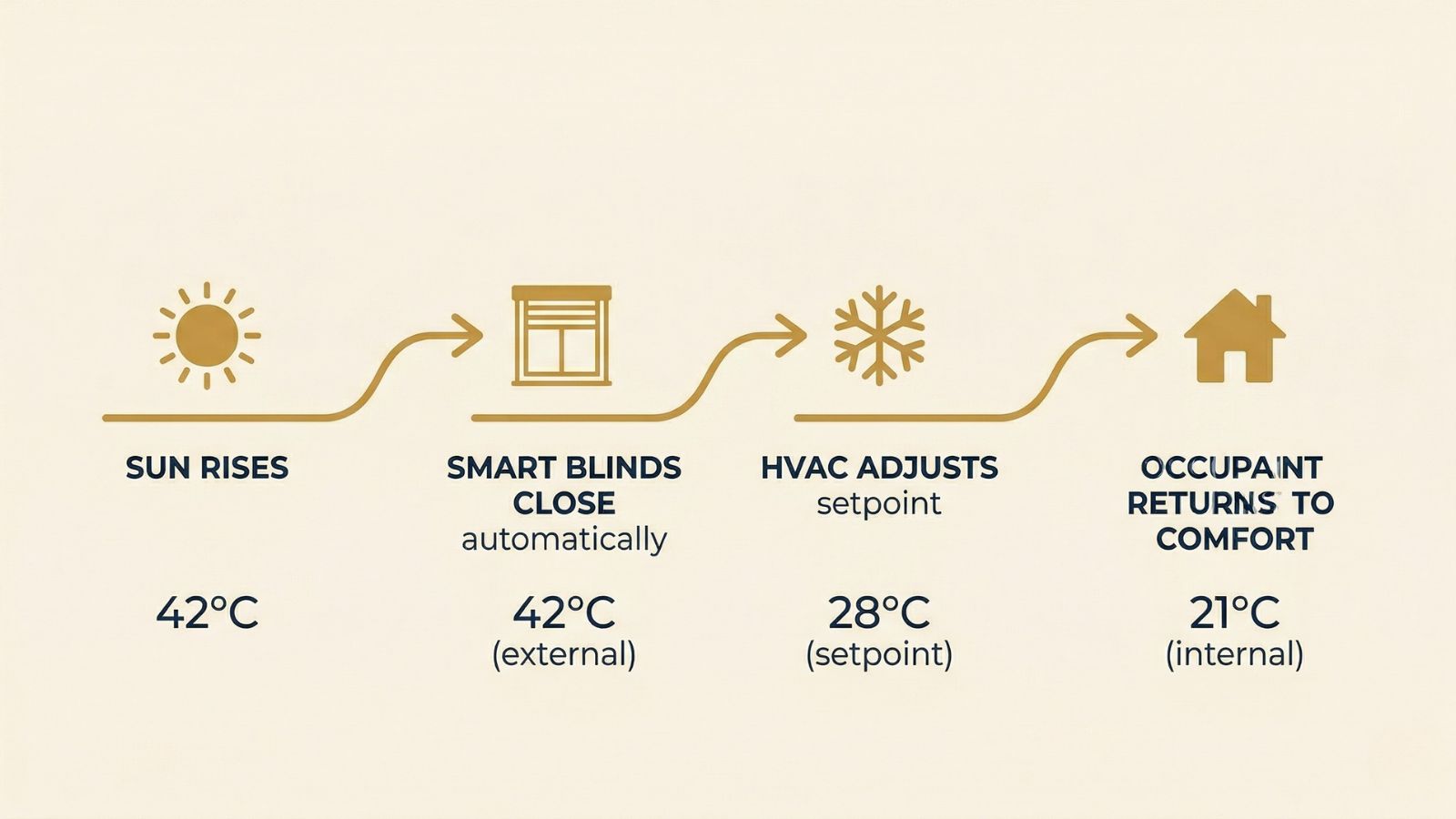
Example workflow: As outdoor temperature rises to 42°C at 9 AM, the system closes east-facing blinds automatically, reducing solar heat gain. The smart thermostat anticipates this and slightly raises the setpoint, reducing cooling load. By noon, the system has already learned this pattern for the previous 100 days and executes the adjustment before temperature peaks. Occupants return home to a comfortable, energy-efficient environment without manual intervention.
This level of automation in a Dubai villa or apartment can reduce cooling costs by 15-25% annually. Over ten years, that's significant capital recovered—and it's a feature prospective buyers notice immediately.
Smart shading alone (automated blinds for a 5-bedroom villa) typically costs AED 8,000-18,000 installed. The ROI timeline: 4-6 years through energy savings, plus the non-quantified comfort benefit.
Security and Access: Biometric Systems and AI Surveillance
Smart home technology Dubai properties rely heavily on access control and surveillance—both personal security priorities in the UAE market.
Modern setups include: biometric door locks (fingerprint, facial recognition, or iris scanning), video doorbells with AI person detection (distinguishing residents, guests, and delivery personnel), 360° CCTV with cloud backup and AI analytics, and smart gate systems integrated with mobile apps.
The AI layer matters here. Rather than recording 24/7 and creating unwieldy footage archives, modern CCTV systems identify anomalies—loitering, attempted forced entry, tailgating—and alert you in real time. Some systems can recognize known faces (residents, staff) versus unknown individuals, reducing false alerts.
Integration with building access: many Dubai apartment communities now offer building-wide smart locks. Mayfair Nexus, for instance, is implementing unified access where your mobile app controls both unit entry and community amenities. You arrive home, and a single biometric scan grants access to your villa, not two separate keys or keycards.
Costs for a comprehensive security smart home setup (biometric locks, quality CCTV, integration) range from AED 15,000-40,000 for apartments, AED 25,000-80,000 for villas. The insurance benefit is real: many UAE insurers offer 10-15% discounts for smart-monitored properties.
Energy Efficiency and Smart Meters: Monitoring What You Pay
Beyond HVAC, smart home technology Dubai real estate increasingly targets granular energy visibility. Smart meters and sub-metering systems show real-time consumption per circuit, per appliance, or per room.
Why this matters: Dubai's electricity is subsidized for Emirati nationals, but expats and property investors face market rates. Understanding where energy consumption concentrates—kitchen appliances? pool pump? landscape lighting?—allows for informed decisions about efficiency upgrades.
Smart power strips and plugs extend this monitoring to individual outlets. A smart plug on your air compressor or workshop equipment reveals actual runtime and cost. Many buyers discover surprise energy drains through this visibility: a guest bedroom's AC running 24/7 unoccupied, a pool pump on an outdated timer, landscape lighting left on unnecessarily.
Integration with solar systems (increasingly common in Dubailand villas) is where smart metering becomes essential. Your system shows real-time solar generation, battery charge/discharge, grid import/export—allowing you to optimize consumption to match solar production. A villa with 10-15 kW solar array plus battery storage can achieve near energy independence with smart orchestration.
Smart meter costs are minimal in new developments (builder-included), but retrofit installations range AED 2,000-6,000 per property. Payback through behavioral savings: 2-3 years for villa owners, longer for apartment dwellers. But the non-financial benefit—control and transparency—appeals strongly to luxury buyers.
Wellness Features: Air Quality, Circadian Lighting, and Whole-Home Comfort
Premium smart homes in Dubai now integrate wellness—specifically indoor air quality and biophilic design through lighting.
Air quality monitoring has become non-negotiable post-pandemic and in a city where outdoor AQI regularly exceeds healthy levels (dust, heat-driven ozone). Smart systems monitor CO2, PM2.5, humidity, and volatile organic compounds, then trigger ventilation automatically. HEPA-grade air purification runs intelligently—ramping up when outdoor AQI spikes, backing off when it improves.
Circadian-rhythm lighting is the feature many buyers discover only after moving in—then wonder how they lived without it. Rather than static brightness, these systems gradually shift color temperature throughout the day: cool blue in morning (stimulating alertness), warm amber in evening (supporting melatonin production). For expats managing jet lag or shift-work sleep disruption, this feature alone justifies smart home investment.
Integration with wellness apps (Apple Health, Oura Ring, etc.) creates closed-loop systems: your sleep data influences tomorrow's bedroom lighting; your activity level triggers lighting brightness adjustments; your calendar alerts the system to dim lights 30 minutes before a scheduled meeting.
These features range from modest (smart bulbs + basic app: AED 1,500-3,500) to premium (circadian-integrated HVAC, air purification, lighting: AED 12,000-25,000). Wellness isn't cheap, but for luxury buyers in Dubai's high-stress climate, it's increasingly non-negotiable.
Smart Home Cost Breakdown: What You'll Actually Pay in 2026
Costs vary wildly based on property type, integration depth, and existing infrastructure. Here's a realistic 2026 breakdown:
Apartment (1-2 bedrooms): Entry-level smart home setup—smart thermostat, smart lighting, video doorbell, basic security—typically AED 2,500-5,000. Mid-tier (integrated climate, security, entertainment): AED 7,500-15,000. Premium (full automation, AI systems, wellness features): AED 18,000-35,000.
Villa (3-5 bedrooms): Basic automation: AED 8,000-15,000. Moderate integration (whole-home HVAC, lighting, security, irrigation): AED 20,000-45,000. Premium (AI climate, comprehensive security, solar integration, wellness): AED 60,000-150,000. Ultra-luxury villas in Emirates Hills or Palm Jumeirah: AED 200,000-500,000+.
Factors affecting cost:
- *Retrofit vs. new build:* Retrofitting existing homes costs 30-40% more due to wiring and integration challenges
- *Ecosystem choice:* Apple HomeKit is premium and closed; Google/Amazon are more affordable and flexible
- *Professional integration:* Using local integrators vs. DIY affects cost by 40-60%
- *Solar/battery addition:* Adds AED 80,000-200,000 but pairs naturally with smart systems
Hidden costs: Many smart systems require yearly maintenance contracts (AED 500-2,000 annually). Cloud storage for CCTV footage runs AED 500-1,500/year. Professional monitoring services add AED 1,000-3,000 annually.
New developments like Mayfair Nexus often include basic smart infrastructure (wiring, hub readiness) in the build cost. Buyers add premium layers afterward, reducing surprise expenses.

ROI on Smart Home Investment: Does It Really Increase Property Value?
The question every luxury buyer asks: Will smart home features increase my property's resale value?
Research from property advisory firms in the UAE and broader MENA region suggests a 8-15% property value premium for homes with mature, brand-neutral smart ecosystems. For a AED 3 million villa, that translates to AED 240,000-450,000 upside—enough to justify AED 50,000-100,000 in smart home investment.
However, caveats matter:
*Brand lock-in reduces appeal:* A villa automated exclusively through a proprietary system that few agents or buyers know decreases resale value. Neutral platforms (Apple HomeKit, Google Home, standard Z-Wave/Zigbee) appeal to wider buyer pools.
*Obsolescence risk:* Technology shifts quickly. Smart homes built with outdated systems (pre-2022 integrations) may require expensive rewiring. Buyers prefer systems launched in the last 18-24 months with clear software support roadmaps.
*Maintenance visibility:* A smart home abandoned for two years—CCTV footage gaps, batteries dead, cloud subscriptions lapsed—is a red flag. Prospective buyers question system stability and future costs. Active, well-maintained systems signal competence and care.
*Climate and security features hold value longer:* HVAC automation and security systems maintain appeal across generations. Entertainment automation (motorized theater seating, wine fridges) dates faster.
From a buyer's perspective in 2026: assume smart home features provide 60-70% of their installation cost back at resale, plus lifestyle value during ownership. Don't invest in smart homes purely for appreciation; invest for the three-to-five-year living experience, and treat resale uplift as a bonus.
For emerging developments like Mayfair Nexus in Dubailand, smart home maturity is a genuine differentiator. Comparable villas in older Dubailand phases lack integration; this gap supports valuation premium.
New Build Smart Homes vs. Retrofit: Why Timing Matters
A critical decision: smart home installation during construction vs. retrofitting an existing property.
New build advantages: Wiring, hub placement, and power distribution are designed for automation. Costs are 30-40% lower because walls aren't opened after finishes. Developers pre-wire major systems (HVAC, lighting circuits, security conduit) to specification. Warranty coverage is cleaner—builder installs core systems; occupant adds premium layers. Soil excavation for solar/EV charging is coordinated upfront.
Retrofit reality: Existing homes require invasive wiring work. Running low-voltage cable through finished walls means drilling, patching, repainting. Some smart features (like motorized blinds requiring track modification) are impractical. Retrofit costs are 40-50% higher. Warranty complications arise: is the builder responsible if smart system interferes with HVAC warranty?
Practical recommendation: For luxury buyers in Dubai, insist on smart-ready infrastructure in new builds (wiring, conduit, hub space, power distribution). Don't overpay for a fully automated property as a new build unless the developer has proven smart home expertise. Instead, buy smart-ready, then commission your own integrator to build the specific ecosystem you want.
Mayfair Nexus is designed with this philosophy: smart-ready infrastructure built in, but residents choose their automation ecosystem post-purchase. This gives you flexibility and prevents you from inheriting a builder's outdated or proprietary choices.
Mayfair Nexus: Smart Living in Boutique Community Design
Mayfair Nexus in Wadi Al Safa 7 approaches smart home technology as part of a broader lifestyle—not merely gadget accumulation.
The community design integrates smart infrastructure into its low-density, villa-first architecture. Every home includes: pre-wired hubs and conduit for future expansion, dedicated solar-ready roof space, EV charging conduit to parking, premium building-grade wiring (not typical apartment-grade), and fiber-ready communication infrastructure.
From a resident experience: your villa can be genuinely off-grid if desired (solar + battery + smart grid management). Or fully connected to community systems—accessing amenities through mobile app, managing common area reservations, receiving infrastructure alerts. The boutique scale means integration is feasible; unlike sprawling master-planned communities, Mayfair Nexus can pilot smart amenity management and refine it based on resident feedback.
Security integration is particularly relevant: boutique communities benefit from unified access control, which Mayfair Nexus implements across entry gates, amenity access, and individual villa entry. This single-point control (via your phone) feels seamless.
Climate control in Wadi Al Safa's specific microclimate—south-facing, elevated terrain—is where smart automation delivers outsized value. Automated shading and predictive HVAC aren't luxury here; they're practical responses to local conditions.
For buyers committed to a 5-10-year horizon in Dubailand, smart home readiness at Mayfair Nexus means you're not paying for unnecessary gadgetry, but you're investing in a property that adapts to your technology choices without costly retrofits.
Smart Home Technology FAQ
What smart home platform should I choose—Apple HomeKit, Google Home, or Amazon Alexa?
For Dubai's luxury market, Apple HomeKit offers strongest privacy and integration quality, but limited device ecosystem. Google Home provides the widest device compatibility and cost efficiency. Amazon Alexa is popular but less favored in UAE due to regional content limitations. Most integrators recommend either HomeKit for privacy-focused buyers or Google Home for flexibility. Avoid proprietary closed systems unless you're committed to one brand long-term.
How much will a smart home increase my property's rental yield?
Smart homes can command 8-12% higher rental rates in Dubai's expatriate market, particularly for furnished villas targeting corporate tenants. However, this premium depends on feature maturity and local familiarity. In Dubailand, where tenant demographics skew toward young families and professionals, well-maintained smart features are increasingly expected, not premium. For pure ROI calculation: a AED 50,000 smart home investment might support an additional AED 3,000-5,000 annual rental income. Payback: 10-15 years. But non-financial benefits (tenant retention, reduced maintenance inquiries) add value.
Will my smart home setup become obsolete in five years?
Yes, partially. Technology evolves rapidly. However, modern systems are designed for progressive upgrade. Your wiring, conduit, and hub infrastructure remain relevant for 10+ years. Individual devices (smart bulbs, thermostats, locks) upgrade affordably every 3-4 years without rewiring. Choose platforms with active developer communities (HomeKit, Google Home) to ensure long-term software support. Avoid one-off proprietary systems. Budget for incremental upgrades, not total replacement.
Do smart homes require ongoing subscription costs?
Yes, though many features work without subscriptions. Cloud recording for CCTV typically requires AED 500-1,500 annually. Professional monitoring adds AED 1,000-3,000 yearly. Smart home hubs themselves don't require subscriptions; apps are free. Budget AED 500-2,000 annually for optional premium features. Mayfair Nexus residents can coordinate community-wide smart infrastructure, potentially negotiating group subscription discounts.
If I buy a smart home property off-plan, can I customize the setup before handover?
Absolutely. Mayfair Nexus allows customization during the build phase. Discuss smart infrastructure preferences with your project manager—wiring routes, hub locations, dedicated electrical circuits for future additions. This pre-handover coordination prevents costly retrofits. You won't typically receive all automation devices at handover (that's your choice), but the framework will be optimized to your vision. Start conversations 6-9 months before handover for maximum flexibility.

Smart Home Investment: The Practical Next Step
Smart home technology in Dubai is no longer aspirational; it's pragmatic. For buyers evaluating properties in 2026, smart-ready infrastructure is a baseline expectation, not a premium add-on.
The real question isn't whether to invest in smart homes—it's *when* and *how deeply*. New-build properties with integrated wiring reduce friction and cost. Buying during construction allows coordination. Choosing platform-neutral systems maximizes long-term flexibility and resale appeal.
For Mayfair Nexus specifically, the combination of smart-ready infrastructure and boutique community scale creates genuine advantage. You're not paying premium pricing for automation gadgets; you're investing in a property designed for future-proofing and flexibility.
Your next step: if smart home features matter to your lifestyle, prioritize properties with quality wiring infrastructure over those with pre-installed (and potentially outdated) systems. Engage an integrator early—even before purchase—to audit a property's smart-ready potential. Ask your broker about fiber connectivity, solar-ready roof space, EV charging infrastructure, and hub placement options.
Ready to explore smart-ready homes in Dubailand? Connect with our team to discuss Mayfair Nexus properties and their automation potential. We can coordinate builder customizations and connect you with trusted integrators for post-handover setup.
Get Started
Discover how Mayfair Nexus villas integrate smart-ready infrastructure into boutique luxury living. Schedule a consultation with our real estate advisors to explore customization options during your home's build phase.