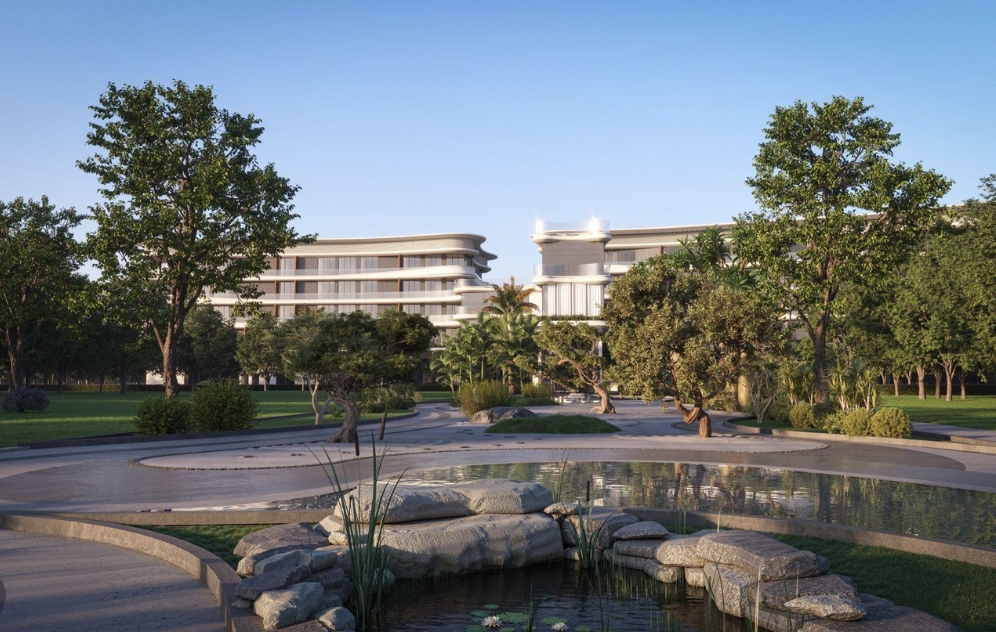
As Dubai residents seek relief from "urban fatigue," Biophilic Design—the architecture of connecting people to nature—has surged in popularity. Zen Gardens act as "healing architecture," offering low-maintenance, water-efficient sanctuaries that significantly reduce cortisol levels and improve mental well-being. Developments like Mayfair Nexus in Wadi Al Safa 7 are leading this trend by integrating dedicated Zen zones, open-air yoga parks, and G+4 low-rise structures to create a "retreat" lifestyle that commands higher rental premiums and tenant retention.
Dubai is a city of superlatives. The tallest tower, the largest mall, the widest highway. For decades, "luxury" in this emirate has been defined by gold leaf, marble floors, and gravity-defying heights.
But as we settle into 2026, a subtle yet powerful shift is occurring in the psyche of the luxury buyer. After years of vertical living in hermetically sealed glass boxes, residents are craving something the skyline cannot offer: Grounding.
Enter the era of Healing Architecture.
Across the globe, and now specifically in Dubai’s new growth corridors like Wadi Al Safa 7, the demand for "Biophilic Design"—buildings that actively connect us to nature—is outstripping the demand for traditional glitz. At the forefront of this movement is Mayfair Nexus, a development that has boldly placed a Zen Garden and Open-Air Yoga Park at the heart of its master plan.
This isn't just landscaping; it is a response to a public health necessity. Here is why the Zen Garden is no longer just a "nice-to-have"—it is the defining amenity of the future.
The Science of Biophilia: Why We Need Nature
To understand why a Zen Garden adds value to a property, we must first understand the biology of the buyer.
Biophilia (literally "love of life") is the scientific hypothesis that humans have an innate, genetic need to connect with nature. When we are separated from it—stuck in traffic on Sheikh Zayed Road or sitting in a windowless office—our stress hormones (cortisol) spike, our cognitive function drops, and our mood deteriorates.
The "90% Indoor" Problem
Research indicates that urban dwellers now spend nearly 90% of their time indoors. In a climate like Dubai’s, this isolation is often amplified.
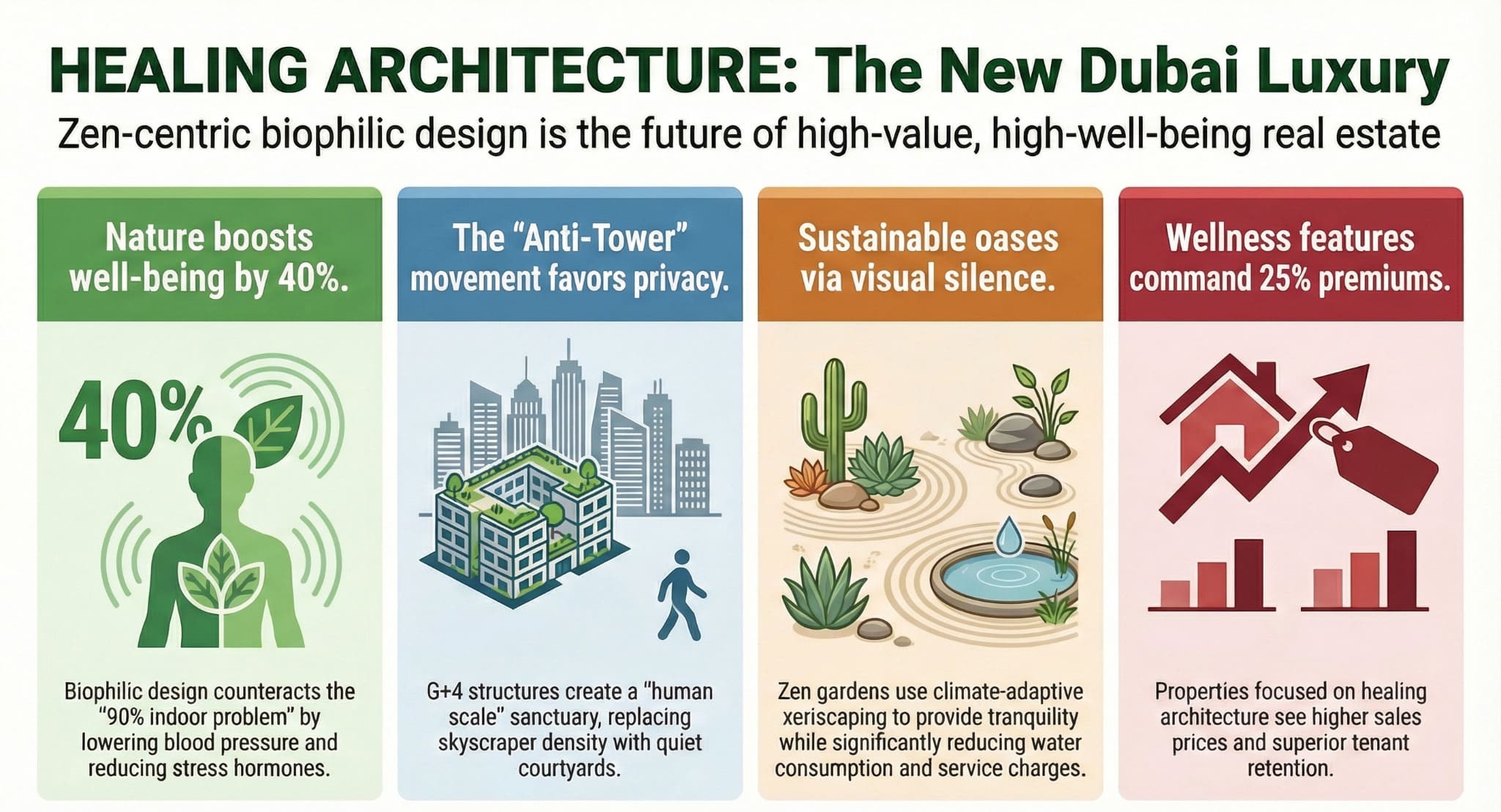
- The Biophilic Antidote: Studies show that even viewing nature can lower blood pressure and heart rate. Integrating direct experiences—like walking through a raked sand garden or sitting under a Ghaf tree—can boost productivity by 15% and improve self-reported well-being by nearly 40%.
When a developer like Seven Mayfair integrates a Zen Garden, they aren't just planting bushes; they are engineering a "cortisol-lowering machine" for their residents.
Escaping the Concrete Jungle: The "Anti-Tower" Movement
For years, the Dubai Dream was a penthouse in the Marina. But the reality of high-density living—elevator queues, noise pollution, and lack of green space—has led to "tower fatigue."
This has birthed the "Anti-Tower" movement, a trend where luxury is defined by Low Density and Privacy.
The G+4 Human Scale
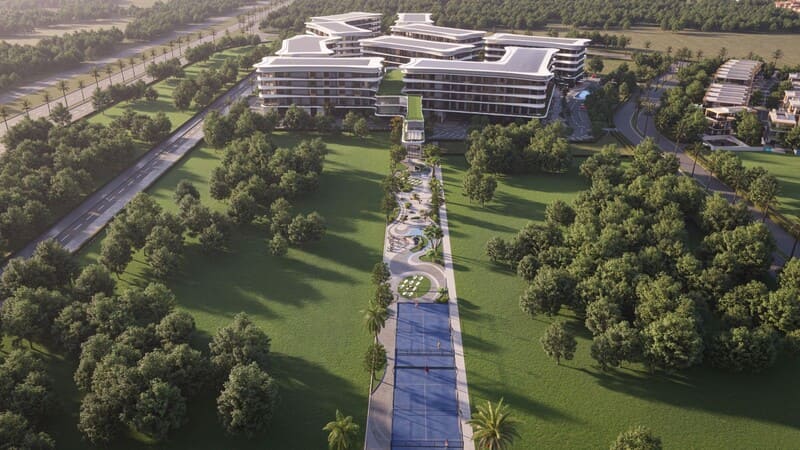
Mayfair Nexus champions this philosophy through its Ground + 4 Floors architecture.
- Psychological Impact: Low-rise buildings maintain a "human scale." You are close to the ground, the trees, and the community. You don't feel like a number in a filing cabinet.
- Visual Silence: Instead of staring at another skyscraper’s façade, residents at Mayfair Nexus look inward toward lush courtyards, pool decks, and the Zen Garden. This "inward-looking" design creates a sanctuary effect, shielding the home from the city’s chaotic energy.
Deconstructing the Zen Garden: More Than Just Sand
What exactly makes a Zen Garden (or Karesansui) different from a regular park? And why is it perfect for Dubai?
1. Minimalism as Medicine
A regular park can be chaotic—kids running, dogs barking. A Zen Garden is curated for stillness. It uses rocks, gravel, and carefully pruned shrubs to create a symbolic landscape.
- The Rocks: Represent mountains or islands (stability).
- The Sand/Gravel: Raked to represent flowing water (fluidity).
- The Effect: The visual simplicity allows the brain to rest. In a city of sensory overload (billboards, supercars, neon lights), a Zen Garden offers "visual silence."
2. Climate-Adaptive Luxury
Dubai creates a unique challenge for greenery. Lush, English-style gardens require massive amounts of water. Zen Gardens, by design, use xeriscaping (low-water landscaping).
- Sustainability: By using gravel, stone, and drought-tolerant plants (like succulents or local desert flora), Mayfair Nexus creates a sustainable oasis that doesn't drain resources, keeping service charges lower for owners while maintaining high aesthetic value.
Mayfair Nexus: A Case Study in Wellness Real Estate
Mayfair Nexus in Wadi Al Safa 7 isn't just "including" wellness amenities; it is building its entire identity around them. Let’s look at how the specific amenities function as "Healing Architecture."
The Open-Air Yoga Park
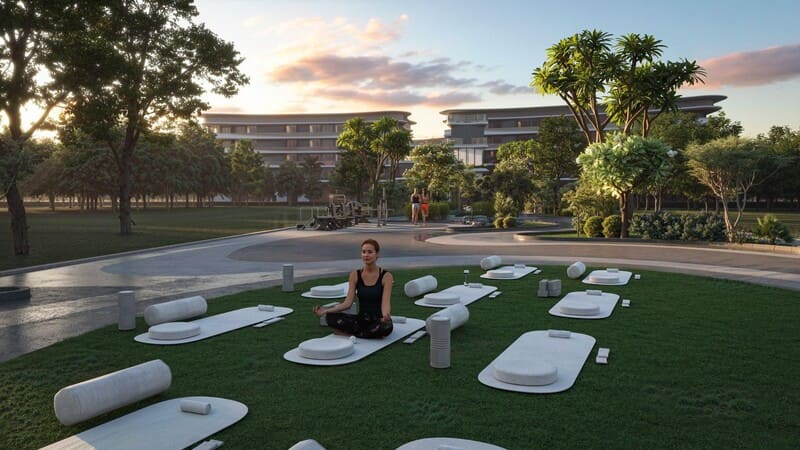
Most apartment gyms are fluorescent-lit rooms in a basement. Mayfair Nexus moves fitness outdoors.
- The Experience: Imagine starting your day with a sun salutation on a dedicated yoga deck, surrounded by bamboo and fresh air, before the heat of the day sets in.
- The Benefit: Outdoor exercise is proven to reduce anger and depression more effectively than indoor training. It turns a "workout" into a "ritual."
The "Refuge" Spaces
Biophilic design speaks of "Prospect and Refuge."
- Prospect: The view from your balcony over the community.
- Refuge: The private nooks within the Zen Garden where you can sit, read, or meditate without being seen. Mayfair Nexus creates these pockets of privacy that are rare in shared apartment complexes.
The Private Jacuzzi
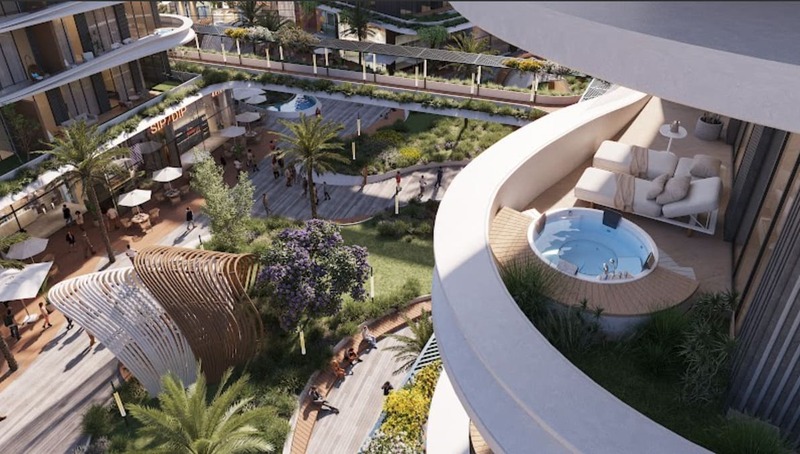
Water is a core element of healing. The sound and feel of water induce a meditative state.
- Private Luxury: By including private jacuzzis in select apartment terraces, Mayfair Nexus brings the spa experience home. It transforms the residence from a place to sleep into a private wellness retreat.
The Investment Case for Wellness
For investors, "Healing Architecture" might sound soft, but the financial returns are hard and tangible.
The "Wellness Premium" Global real estate data suggests that developments within "wellness communities" command sales premiums of 10–25% over conventional buildings.
- Tenant Retention: Tenants who feel mentally healthy and relaxed in their homes stay longer. The Zen Garden isn't just for them; it’s an asset protection strategy for you. It reduces turnover costs.
- Future-Proofing: As Gen Z and Millennials (who prioritize mental health over status) become the dominant renters and buyers, properties without wellness amenities will face obsolescence.
Wadi Al Safa 7: The Perfect Canvas
You cannot build a Zen sanctuary in the middle of a highway intersection. Location matters.
Wadi Al Safa 7 is inherently conducive to this lifestyle.
- Low Noise: It is a residential district away from the flight paths and 12-lane highways.
- Air Quality: Further inland from the humidity of the coast and the smog of the dense city center.
- Green Context: Surrounded by The Sustainable City and Arabian Ranches, the entire district breathes.
Buying Peace of Mind
In 2026, a luxury home is no longer defined by the brand of the kitchen appliances (though Mayfair Nexus has premium ones). It is defined by how the home makes you feel.
Does your home raise your blood pressure, or lower it? Does it drain your energy, or restore it?
By integrating Zen Gardens, Open-Air Yoga Parks, and Low-Rise Architecture, Mayfair Nexus answers these questions decisively. It offers a rare commodity in Dubai: Sanctuary.
For the investor, it’s a smart bet on the future of tenant demand. For the residents, it’s simply a better way to live.
Come home to the quiet. Come home to Mayfair.
FAQs
1. What is biophilic design in real estate?
Biophilic design is an architectural approach that connects building occupants more closely to nature. It incorporates elements like natural lighting, ventilation, indoor plants, water features (like jacuzzis), and landscape views to improve mental and physical well-being.
2. How do Zen Gardens improve mental health?
Zen Gardens (Karesansui) use minimalist arrangements of rocks and sand to create a calming, clutter-free visual environment. Research shows that spending time in such spaces lowers cortisol (stress) levels, reduces anxiety, and improves focus by providing a "restorative" escape from urban stimuli.
3. Does Mayfair Nexus have a gym and yoga area?
Yes, Mayfair Nexus features a comprehensive wellness suite, including a fully equipped indoor fitness center and a dedicated Open-Air Yoga Park. These spaces are designed to facilitate both high-intensity workouts and mindful restorative practices.
4. What are the benefits of G+4 low-rise apartments?
G+4 (Ground plus four floors) buildings offer a "human scale" living experience. Benefits include faster access to the ground floor (no long elevator waits), a stronger sense of community connection, less noise pollution, and a higher ownership share of the land compared to high-rise towers.
5. Is Mayfair Nexus located in a quiet area?
Yes, Wadi Al Safa 7 is a peaceful, master-planned residential district. Unlike the busy hubs of Business Bay or Marina, it is a low-density "enclave" characterized by villas and green spaces, making it ideal for families and professionals seeking tranquility.
6. Are private jacuzzis available in all Mayfair Nexus apartments?
Private jacuzzis are a premium feature available in select units, typically those with larger terraces or specific 2-bedroom and 3-bedroom layouts. It is recommended to check the specific unit floor plan or contact the sales team for availability.
7. How does wellness real estate impact rental yields?
Wellness-focused properties often command higher rental yields (typically 10-15% premiums) because tenants are willing to pay more for amenities that improve their quality of life. Additionally, these properties tend to have lower vacancy rates and higher tenant retention.
8. Can I use the Zen Garden if I rent at Mayfair Nexus?
Yes, the Zen Garden, Cinema Lounge, Pool Deck, and Yoga Park are communal amenities accessible to all residents (owners and tenants) of Mayfair Nexus, fostering a shared sense of community well-being.
9. Is the Zen Garden suitable for the Dubai climate?
Yes. Zen Gardens are uniquely suited to Dubai because they utilize xeriscaping principles. They rely heavily on rocks, sand, and drought-tolerant plants rather than water-intensive grass, ensuring the amenity remains beautiful and sustainable year-round despite the heat.
10. When will the wellness amenities at Mayfair Nexus be ready?
All amenities, including the Zen Garden and Yoga Park, are scheduled to be completed and operational by the project's handover date in Q4 2028.